
Roman Numerals Converter
How to Use Roman Numerals Converter
Follow these simple steps to get the most out of the Roman Numerals Converter.
Enter Number
Input the numerical value you want to convert or calculate.
Select Base/Format
Choose the numeral system or specific formatting operation.
Copy Result
Your converted number will appear in the output area, ready to use.
Roman Numerals Converter – Convert Numbers to Roman Numerals Instantly Online
What Are Roman Numerals?
Roman numerals are a numeral system originating in ancient Rome that uses Latin letters to represent numbers. They remain in common use today across film titles (Rocky IV), sporting events (Super Bowl LVIII), book chapters, clock faces, and formal documents. 2025 in Roman numerals is MMXXV (MM = 2000, XX = 20, V = 5).
Roman Numeral Symbols
💡 Long-tail keyword placement: Target: ‘roman numeral for 50 100 500 1000’, ‘roman numerals 1 to 100’
- I = 1 | V = 5 | X = 10 | L = 50 | C = 100 | D = 500 | M = 1000
The subtractive rule: a smaller symbol before a larger one is subtracted. IV = 4, IX = 9, XL = 40, XC = 90, CD = 400, CM = 900.
- 1 = I | 4 = IV | 5 = V | 9 = IX | 10 = X | 14 = XIV | 40 = XL | 50 = L
- 90 = XC | 100 = C | 400 = CD | 500 = D | 900 = CM | 1000 = M | 1999 = MCMXCIX | 2024 = MMXXIV | 2025 = MMXXV
Where Are Roman Numerals Used Today?
- Analog clocks and watches — many luxury watch brands use Roman numerals for hour markers
- Film sequels — Rocky IV, Fast X, Star Wars: Episode VII
- Sports championships — Super Bowl LVIII, Olympic Games
- Monarchs and popes — King Charles III, Pope Francis I
- Book chapter and volume numbering, legal document section numbering
- Building cornerstones and commemorative inscriptions displaying the year of construction.
Try Our Other Free Tools
VersaTools offers a complete suite of free online utility tools — no signup required.
- Base Converter → https://versatools.in/number-systems/base-converter/
- Percentage Calculator → https://versatools.in/number-systems/percentage-calculator/
- Number to Words → https://versatools.in/number-systems/number-to-words-converter/
- Word Counter → https://versatools.in/text-tools/word-counter/
- Case Converter → https://versatools.in/text-tools/case-converter/
- Length Converter → https://versatools.in/unit-converters/length-converter/
Frequently Asked Questions :
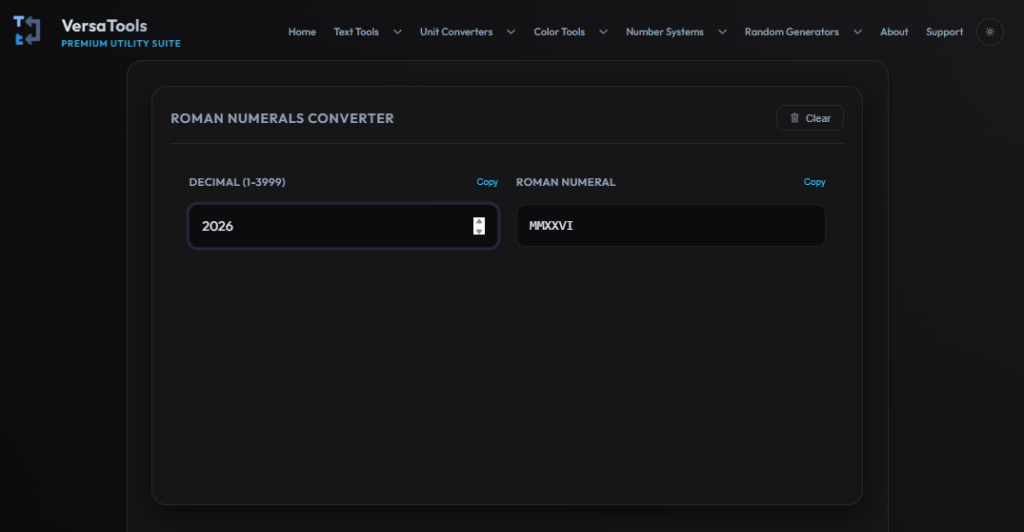
2026 in Roman numerals is MMXXVI. Breakdown: MM = 2000 + XX = 20 + VI = 6 = 2026.
IV uses the subtractive rule: I (1) placed before V (5) means 5−1 = 4. You cannot write IIII because symbols cannot be repeated more than three consecutive times. Some traditional clock faces still use IIII, but IV is the standard form.
In standard notation, the largest expressible number is 3999 (MMMCMXCIX). Using M four times (MMMM) would violate the three-repetition rule. Extended systems using overbars (Vinculum) can represent larger numbers, but these are rarely encountered in everyday use.